Endurance Gold has reported extensions to two gold-antimony zones at its Reliance brownfield project in British Columbia as it advances a preliminary economic assessment. According to The Northern Miner, the latest drilling adds to work aimed at expanding an initial inferred resource of 1.45 million ounces of gold announced earlier this year. Antimony has been encountered in this year’s drilling but was not included in that resource estimate.
Hole DDH26-140 pushed the Imperial zone 50 metres further northwest, returning a 5.2-metre interval grading 5.89 grams of gold per tonne and 0.19% antimony from a depth of 405 metres. At Lower Imperial, hole DDH26-137 extended the zone 55 metres southeast, with 16.2 metres grading 2.24 grams of gold per tonne and 0.06% antimony from 526 metres. Endurance released the results on Wednesday, the outlet reported.
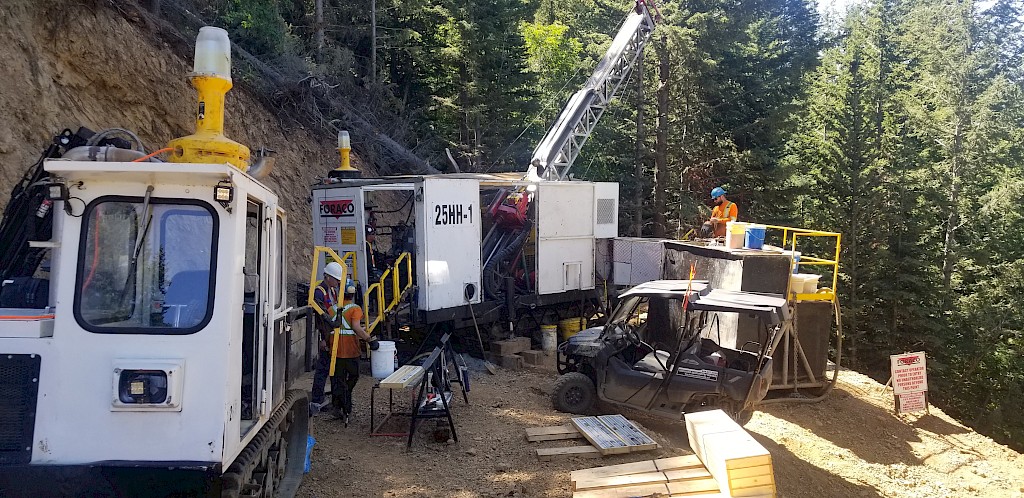
Another intersection, in hole DDH26-134A, returned 10.9 metres grading 3.96 grams of gold per tonne and 1.92% antimony from 304.5 metres. The reported results came from a drilling programme covering more than 10,200 metres in 25 holes across the Eagle, Crown and Imperial zones, according to Endurance. Chief executive Robert T. Boyd said the work had enlarged both Imperial zones and identified additional high-grade structures outside the previously delineated mineralisation. He described scope for further mineralised volume along the Royal Shear and its associated footwall.
Reliance’s current inferred resource comprises 19.6 million tonnes grading 2.3 grams of gold per tonne. Within that total, the pit-constrained portion accounts for 15.6 million tonnes at 2.23 grams per tonne, containing 1.12 million ounces. In a Wednesday research note cited by The Northern Miner, Atrium Research analyst Ben Pirie highlighted the increasing number of narrow, high-grade footwall structures. He identified forthcoming Crown assays and initial Eagle Offset results as potential drivers for the near-surface resource, while viewing the deeper Imperial intersections as supporting underground growth.
The project lies roughly 180 kilometres northeast of Vancouver on ground explored for antimony more than a century ago. It subsequently hosted the Minto gold mine, which produced approximately 17,500 ounces between 1934 and 1940.